Bynder vs Aprimo: Which DAM platform is right for your team?
Bynder is purpose-built for digital asset management (DAM); Aprimo evolved from marketing resource management (MRM). That origin shapes how each platform is configured, adopted, and connected to channels.
- Easier to adopt and run: G2 reviewers rate Bynder higher for ease of use (8.8 vs. 8.2), setup (8.3 vs. 7.9), and admin (8.6 vs. 8.0).
- Built to grow with you: Easy to set up for lean teams, ready for global enterprises, with delivery to channels built into the platform. Trusted by 4,000+ brands.

Voted #1 DAM solution

Forrester® Customer Favorite
Last updated: November 2026
Author: Ashley Musselman
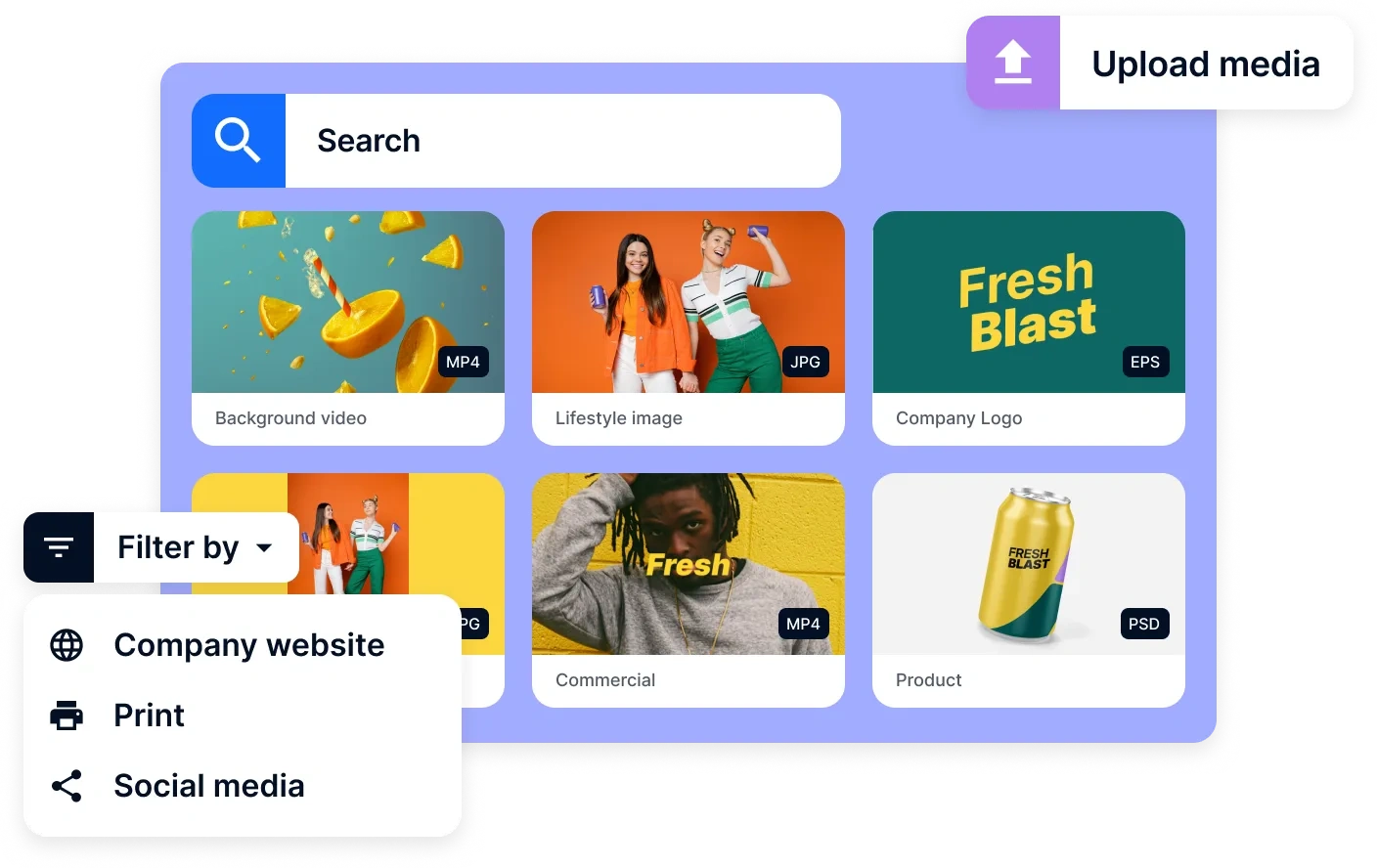
Bynder vs Aprimo at a glance
Both platforms cover the core of digital asset management: centralized storage, taxonomy and metadata, search, and governance. The differences show up in where each platform started, how it's configured and adopted, and how content reaches its destination.
Criteria | Bynder | Aprimo |
|---|---|---|
Platform origin | Purpose-built for digital asset management from the start | Started as a marketing resource management vendor in 1998; added DAM in 2017 through its acquisition of ADAM Software |
Implementation | Configured to your needs, not custom-built. Taxonomy, permissions, and workflows are set up through the interface instead of development work, and the intuitive UI means most users need little to no training. Most teams are live in weeks and see value sooner | Complex configurations and integrations often call for specialized development effort, and longer timelines are common for complex deployments. A heavier platform can also mean more training before teams are productive |
AI agents & automation | A Human-led, AI powered Agentic Platform that extends the capability of the industry-leading DAM using customizable, context aware AI Agents Enrichment, Brand Compliance, Transformation, and Governance, running inside the DAM | Five AI Agents, Planning, Librarian, Critic, Compliance, and Production, spanning DAM and the wider marketing operations platform |
AI-powered search | Eight AI powered search capabilities including natural language, face recognition, text-in-image, similarity, and speech-to-text, all included in one price and working from day one, with no model training or per-query charges | AI search, similarity matching, OCR, and speech-to-text. Some AI capabilities are packaged as separate products, and brand-specific tagging involves training a model |
Content delivery | Native content experiences (CX User Community and CX Omnichannel) built into the platform | Typically relies on third-party tools for content delivery |
Marketing resource management (MRM) | Bynder’s DAM platform is open and composable with [INTEGRATIONS]+ pre-built integrates including the industry leading MRM platforms | A core strength and the company's original category, planning, spend, and productivity management alongside DAM |
Security certifications | Enterprise-grade security: ISO 27001, ISO 27018, ISO 22301, SOC 2 Type II, PCI DSS, HIPAA | SOC 2 Type II and GDPR, per Aprimo's trust center. Confirm current certifications and their scope with any vendor directly. |
Best fit | Teams that want DAM depth: fast configuration, broad adoption across the business, and built-in content delivery | Teams whose primary requirement is marketing resource management, with DAM as a secondary need |
Platform origins: DAM-first vs. MRM-first
Where a platform started tells you what it optimizes for, and this is the clearest structural difference between the two.
Aprimo was founded in 1998 and, in its own words, "pioneered the category of marketing operations management and later expanded to lead in digital asset management." DAM became part of the platform in March 2017, when Aprimo acquired ADAM Software, an acquisition Forrester covered at the time as a signal of consolidation in the market. Today DAM sits alongside planning, spend, and productivity modules in a marketing operations suite.
Bynder was built as a DAM platform and has maintained the focus ever since. Everything around the platform core, AI powered enrichment, brand compliance, content delivery, extends the job of managing and distributing assets rather than widening into adjacent categories.
Neither history is a flaw, and this isn't a question of which company is better. It's a question of what your team is actually buying. If the asset library is the center of gravity, a DAM-first platform concentrates its investment where you need it. If marketing planning and budget management are the primary problem, a suite that covers both may have appeal.
Implementation and time to value
The implementation approach is one of the most consistent differences buyers report between the two platforms. Aprimo's complexity as a combined DAM and MRM platform means implementations often require more development, configuration, and third-party system integrators are commonly brought in for enterprise deployments, a pattern documented in G2 and Gartner Peer Insights reviews.
Bynder’s onboarding is led by an in-house team of specialists covering taxonomy design, configuration, and training. Most teams are live within weeks, not months, and the same team helps them turn go-live into measurable results, such as faster asset retrieval and less rework. For organizations that want a short path from purchase to adoption to real business value, this is typically the more direct route.
AI capabilities compared
Bynder and Aprimo both offer AI agents. The real differences are how the agents are governed, how they are packaged, and how they connect to the AI tools your teams already use.
How Aprimo approaches AI agents
Aprimo offers five agent types across its marketing operations platform. Planning Agents build campaign and creative briefs. Librarian Agents generate metadata using OCR, facial recognition and brand-trained tagging models. Critic Agents review tone, sentiment and composition. Compliance Agents check content against brand, legal and industry rules such as FDA and FINRA. Production Agents edit images, write copy variations and localize content.
In September 2026, Aprimo launched Content Portfolio Management (CPM), which runs its Librarian, Critic and Compliance agents on content outside the DAM. CPM is a separate product, so buyers should confirm which agents and modules their license includes.
How Bynder approaches AI agents
Bynder’s Agentic Platform is human-led and AI-powered. Your teams direct the agents, set the rules and own the outcome. The agents apply those rules automatically and flag exceptions for human review. Global AI instructions, rules and permissions sit in the AI Control Center, and every agent is created and managed in the Agent Library.
Bynder offers four types of AI agents:
- Enrichment Agents extract visual and contextual detail from each asset and map it to your taxonomy, from alt-text to video summaries and multilingual metadata, so assets can be discovered, reused, personalized and activated downstream.
- Brand Compliance Agents check assets against your brand rules and regulations across multiple brands and markets, using a purpose-built detection engine for logos, text and color.
- Transformation Agents remove or replace backgrounds, expand and resize images, and edit images from a prompt, so approved assets can be adapted for new markets, campaigns and seasons without reshoots.
- Governance Agents scan the web, including distributor, retailer and reseller sites, to flag outdated, expired or unauthorized assets, uncover counterfeits and show where content is used.
The results are measurable. AdventHealth saved more than 180 workdays by using the Enrichment Agent to make 18,000 assets WCAG compliant, and Specsavers cut zero-result searches by 40%.
Governing content beyond the DAM
Content rarely stays in one place, and both vendors now govern it where it lives. Aprimo does this through CPM, a separate product that also covers internal file storage such as SharePoint and Google Drive. Bynder automates governance at scale: its agents apply brand, compliance and quality policies to content wherever it is stored and flag exceptions for human review. Governance Agents run on the same Agentic Platform, with the same controls and approvals, as every other Bynder agent.
Bringing your DAM into AI assistants with MCP
Bynder MCP connects Claude, Microsoft Copilot, ChatGPT, Figma and other MCP-compatible assistants directly to your DAM. Users can find approved assets in plain language and ask questions about published brand guidelines without leaving the assistant. Existing permissions, rights, geography and expiry rules still decide what each user can see.
Bynder MCP also works alongside MCP servers for PIM, CMS and marketing automation, and Agent APIs make Enrichment Agents callable from external systems. Aprimo also offers an MCP server, which its developer documentation lists as requiring an AI Elite license.
AI-powered search
Bynder gives every user multiple ways to find content beyond metadata:
- Natural language search: Describe what you need in plain language, with no structured keywords required.
- Face recognition: Surface images of specific people across your entire library.
- Text-in-image search: Search any image that contains text by that text.
- Similarity search: Find visually similar assets to boost reuse and reduce redundant content creation.
- Speech-to-text: Search audio and video files by their spoken content.
Across all of it, your teams set the direction and the rules, the agents execute, and people review the exceptions.
Content delivery and distribution
Getting approved content out of the DAM and into the channels where it's used is a separate capability from storing it, and platforms handle this differently. Aprimo customers typically pair the platform with third-party tools to deliver content externally.
Bynder includes two native delivery capabilities directly in the platform: Content Experiences for User Communities, which gives partners and collaborators branded, self-service access to curated asset portals, and CX Omnichannel, which delivers optimized images and video to digital channels with transformations applied at the point of delivery. Neither requires separate middleware.
Security and compliance
Both platforms serve regulated industries, so security posture is worth confirming directly against your organization's requirements. Bynder holds certifications including ISO 27001, ISO 27018, ISO 22301, SOC 2 Type II, and PCI DSS, and is HIPAA-compliant, with GDPR and CCPA compliance built in. Built-in digital rights management allows fine-grained control over access, downloads, and distribution, including expiry-based access for licensed content.
Which platform fits your team
The right choice depends on what your team needs most from a DAM.
Aprimo may be the better fit if your priority is Marketing Resource Management with a supporting DAM combined in a single platform, and your team has the resources to manage a more involved implementation.
Bynder may be the better fit if you want to go live quickly with a platform your teams can configure and adopt without heavy development or training, and want content delivery to partners and channels handled within the platform without additional tools.
Bynder was named a Leader in The Forrester Wave™: Digital Asset Management Systems, Q1 2026, scoring highest in Strategy (4.6) and earning the Customer Favorite designation, the only vendor in the evaluation to receive it.
Frequently asked questions
Is Bynder better than Aprimo?
How does Bynder's AI compare to Aprimo's?
Which is easier to implement, Bynder or Aprimo?
Does Aprimo have digital asset management?
Is Bynder or Aprimo more secure?
See Bynder in action
If native AI automation, fast implementation, and built-in content delivery are priorities for your team, book a demo to see how Bynder's platform works, or explore our DAM comparison guide to compare vendors side by side.