
Overview
At Bynder, we are committed to creating a healthy and inspiring work environment that enables our stakeholders to thrive. We have adopted and are continuously implementing technology, policies, and procedures that focus on the areas important to our business and the various stakeholders we interact with.
Principles
We align our policies and use the United Nations Sustainable Development Goals (SDGs) as a guideline for our reporting. We have developed methodologies that assist us in quantifying and explaining our journey towards achieving our goals in line with the SDGs and have policies and papers on environmental and social fields.
- Goal: Usage of affordable and sustainable energy (SDGs #7)
- Goal: Ensure sustainable consumption and production patterns (SDGs #12)
- Goal: Take actions to combat climate change and its impact (SDGs #13)
Bynder is also a signatory of AWS The Climate Pledge, committing to net-zero carbon emissions.
1. Environmental
Our business and actions aim to reduce environmental impact by taking measures that support environmental sustainability. We ensure our suppliers and business operations reduce their environmental footprint by taking climate-focused actions.
We measure emissions from our own operations and cloud hosting. Our 2025 baseline is Bynder-calculated and not externally assured. It excludes business travel, commuting, and other purchased services.
- Own operations: Scope 1: 52 t CO2e. Scope 2: 181 t (location-based) and 256 t (market-based). Energy use: 1.04 GWh. This is about 0.54 t CO2e per FTE (market-based). Where local infrastructure allows, we separate waste in our offices.
- Cloud hosting: AWS attributes 313 t CO2e (market-based) to our usage in 2025, about 74% lower than the location-based figure (1,223 t), reflecting AWS’s renewable energy procurement. AWS reports that 100% of the electricity consumed by Amazon’s global operations was matched with renewable energy in 2025, including in the EU and US regions that host most of our workload. This is an annual matching, partly through renewable energy certificates and guarantees of origin.
Technology and AI
Bynder runs on AWS infrastructure, which optimizes energy consumption and lowers its carbon footprint compared to on-premises data centers. Our multi-tenant SaaS uses shared resources and automatically scales up and out under peak loads, and scales down when demand subsides to conserve power. As the system of record for all digital content, Bynder minimizes storage footprint even for the largest asset collections. Our AI Search experience delivers exceptional productivity improvements by reducing the time and effort to find, reuse, and repurpose assets, translating into proven cost efficiency for clients and lower processing and power consumption in the cloud. Our Agentic platform operates within the same on-demand shared infrastructure, enriching and transforming trusted, on brand assets in the system of record, further optimizing computing and power consumption.
2. Social
Our approach
Our people are at the heart of Bynder’s success. We manage workforce topics in line with the Global Reporting Initiative (GRI) standards and map them to the UN Sustainable Development Goals (SDGs), focusing on SDG 3 (good health and well-being), SDG 4 (quality education), SDG 5 (gender equality), SDG 8 (decent work), and SDG 10 (reduced inequalities).
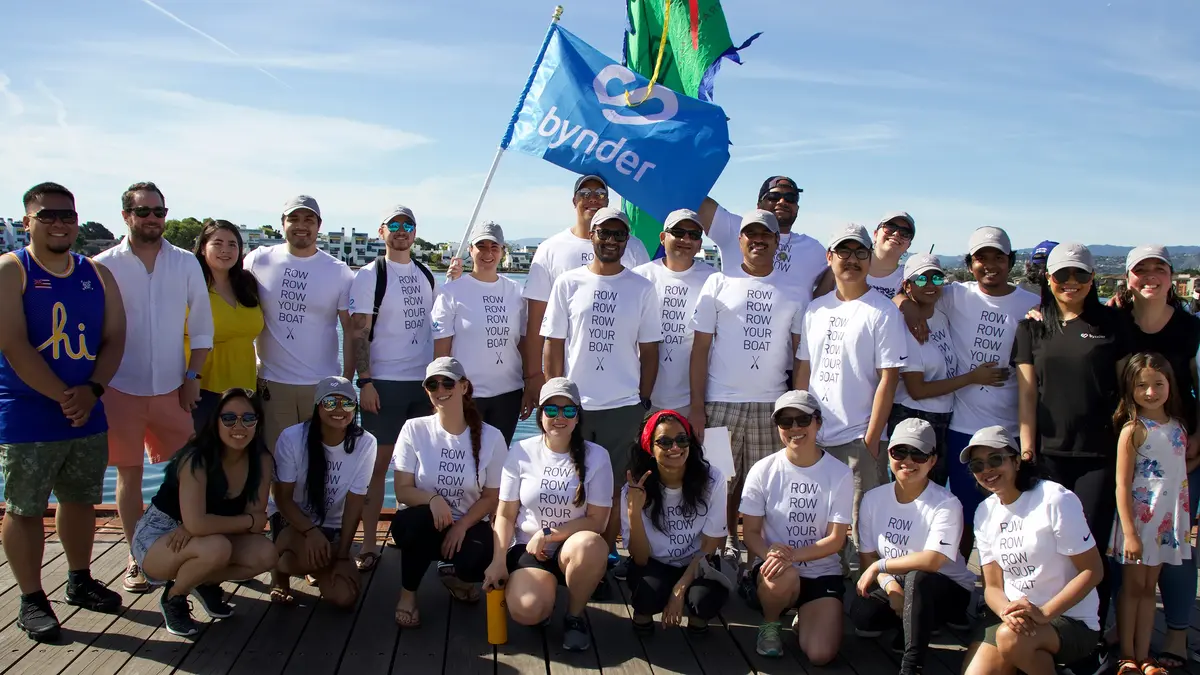
A global, multicultural workforce (SDG 8, 10)
Bynder has more than 550 employees across 8 offices, representing over 54 nationalities. Our differing perspectives help us build products for global brands and create an environment that supports growth and individual well-being.
Independently benchmarked inclusion (SDG 10, 5)
We are a member of Workplace Pride, a non-profit advocating for LGBTIQ+ inclusion at work. In the Workplace Pride Global Benchmark, Bynder scored 63.3%, which is 13 points above the 50.3% median, and improved its score by over 20% year on year. We use the benchmark’s findings to guide our inclusion priorities.
Employee-led communities (SDG 5, 10)
Our Employee Resource Groups give employees a voice in shaping our workplace, and each is sponsored by a member of the executive team:
- Bynder Pride supports LGBTQI+ colleagues and allies through advocacy and networking.
- Neurodiversity Umbrella Alliance, sponsored by our CTO, supports neurodivergent colleagues and allies.
- Bynder Women provides mentorship, growth, and support for women and allies.
Transparency and accountability (GRI 405-1)
We publish workforce demographics, including gender, race and ethnicity, age and leadership representation, and have done so since 2020. Our data is updated annually (latest: 2025). In the EU, demographic data is collected on a voluntary basis in line with GDPR, so some figures reflect self-reported responses. See our Diversity, Equity & Inclusion page for the full data.
Learning, wellbeing, and fair work (SDG 3, 4, 8)
We provide learning and development opportunities, a safe working environment, and fair pay. These commitments are set out in our Global Code of Conduct & Ethics.

3. Governance
Our board receives updates on human capital, ESG and cybersecurity risks. We report our sustainability performance through EcoVadis, where we currently hold a Bronze medal (Top 35%) with an overall score of 65/100 (72nd percentile), published 21 November 2025. We are in the process of reassessment. Our security and resilience controls are independently audited and certified: SOC 2, ISO 27001, and ISO 22301. In 2025, 100% of employees completed data security training.
Bynder is committed to ethics, social benefits, and embracing equality in our corporate and management governance structure. We seek to ensure that our actions are anchored in best corporate governance practices through ethical and responsible conduct.
- Goal: Ensure sustainable consumption and production patterns (SDGs #12)
- Goal: Promote peaceful and inclusive societies for sustainable development, access to justice for all, and effective, accountable, and inclusive institutions at all levels. (SDGs #16)