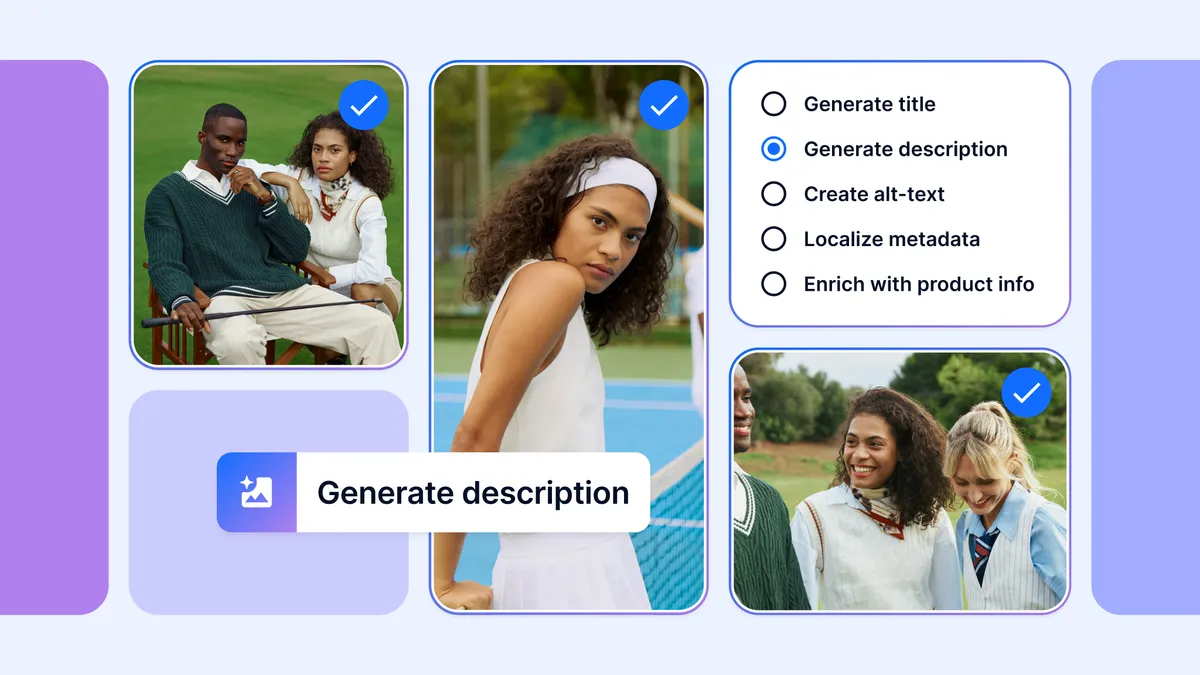
Asked which part of the content supply chain they most want AI agents to optimize, 48% of Bynder customers chose tagging and metadata enrichment. Every other use case, including content creation, localization, channel adaptation, compliance, and performance analysis, drew between 7% and 13%.
We surveyed 120 Bynder customers at Bynder Connect in September 2026 and compared the results with our State of DAM 2026 research, a January 2026 survey of 2,000 business and marketing leaders at organizations with digital asset management (DAM) platforms. This page covers what customers want from AI agents, what AI in DAM has already delivered for them, and why a growing volume of AI-touched content makes governed, well-described assets more important.
Key takeaways
- 48% prioritize tagging and metadata enrichment for AI agents, compared with just 7–13% for other applications.
- AI adoption is adding to content complexity: 91% report more AI-touched content, while 87% face growing operational demands.
- 95% of Bynder customers report increased ecommerce revenue from AI in DAM, compared with 26% of DAM users overall.
- Bynder customers also report higher rates of productivity gains (83% vs. 37%) and operational efficiency improvements (78% vs. 34%).
DAM users look to AI agents to enrich content and boost performance
Existing AI capabilities in DAM support tasks such as asset search and enrichment; AI agents go further by using context and business rules to handle more complex workflows. The priority use cases for agents chosen by customers offer a clearer picture of where they want agents to help. Asked which area of the content supply chain they most wanted to optimize, one use case stood out above the rest: metadata enrichment. 48% selected tagging and metadata enrichment, while other applications, including content creation, localization, channel adaptation, compliance, and performance analysis, were chosen by between 7% and 13%.
At Channel 4, that need is already evident:
Tagging all the assets manually upon upload is a big bottleneck for us because of the sheer volume. I genuinely think that AI agents can be really helpful with that. We can enrich our metadata and also achieve faster tagging for our downstream systems.Stephen Green
Senior Asset and Integrations Manager at Channel 4
For Channel 4, faster tagging could reduce manual work and support downstream workflows. The survey suggests similar priorities among Bynder customers, who are looking beyond creative automation toward improvements in infrastructure, content management, and governance.
These opportunities depend on the context and business rules held in DAM, allowing agents to address specific operational needs within governed workflows.
What customers expect from AI agents
Customers are optimistic about some applications of AI agents, but their expectations are far from uniform. 55% of respondents believe agents could boost content performance; when asked about reducing creative production costs, however, 52% were unsure, 40% did not expect that benefit.
While customers report benefits from existing AI capabilities in DAM, including lower creative production costs, they remain cautious about whether AI agents will deliver similar savings. That uncertainty may reflect reluctance to rely on generative AI for creative production, with human creatives and agencies expected to remain part of the process. A human-led approach reflects that balance: agents can support defined workflows, while people retain responsibility for creative judgment, governance, and the final outcome.
AI is scaling content demand and complexity
The growing reach of AI is evident when we look at how much content gets ‘touched’ by AI at some point in the content lifecycle. In the original State of DAM 2026 research, 75% of respondents said at least a significant proportion of their content had passed through an AI-powered process; in the Connect survey, 91% of Bynder customers reported that the proportion of AI-touched content had increased over the preceding 12 months.
The distinction between AI-touched and AI-generated content matters. AI is involved in far more than creating new assets; existing content can pass through AI-powered tagging, search, governance checks, compliance evaluations, or adaptation and reformatting for different channels or campaigns. As these capabilities become part of everyday workflows, teams must manage not only more content but also more ways to process and use it.
In just six months, 87% of surveyed Bynder customers reported increased demand or complexity in their content operations, even as AI capabilities become more widely used.
Bynder’s customer, Mazda Motor Corporation illustrates the challenge. The company supports localization for more than 1,000 dealers across Europe; as local teams increasingly use AI-powered tools, maintaining brand consistency and control becomes more demanding.
Campari Group highlighted a related challenge as employees increasingly seek to use AI at work:
Now that AI tools are more prevalent among the general public, people want to leverage them at work, not just in their day-to-day home life. The challenge is finding the technology that allows you to do that, with the guardrails and governance you need to deploy it. I think it is probably one of the biggest challenges that any business will face.Romney Whitehead
DAM Product Owner at Campari Group
AI is not simply an add-on to content operations; it is changing the volume, pace, and nature of the content being managed, along with the expectations and workflows surrounding it.
AI in DAM is moving from promise to measurable impact
Despite ongoing skepticism about whether AI delivers measurable returns, the Connect findings point to benefits beyond productivity and efficiency, with a direct impact on the bottom line. Customers report improvements in how quickly content reaches the market, what it costs to produce, and the revenue it helps generate.
These outcomes were also measured in the original State of DAM 2026 research. Bynder customers surveyed at Connect reported benefits from AI capabilities in DAM at higher rates across all five outcomes:
Reported outcome from AI in DAM | DAM users overall (Jan 2026) | Bynder customers (Sept 2026) *smaller sample size |
Higher team productivity | 37% | 83% |
Better operational efficiency | 34% | 78% |
Faster time to market | 29% | 75% |
Increased ecommerce revenue | 26% | 95% |
Lower creative production costs | 25% | 76% |
The Connect findings suggest AI in DAM is moving beyond productivity gains to become a revenue driver: 95% of surveyed Bynder customers report increased ecommerce revenue from AI capabilities in DAM over the last 12 months.
The next phase of AI in content operations is about purposeful scale
With 91% of customers reporting more AI-touched content and 87% facing greater demand or complexity, the Connect findings point to the need for more intentional AI use across enrichment, findability, governance, transformation, activation, and performance. The DAM is the governing system of record, connecting assets to the metadata, permissions, and brand rules that keep content reliable and ready for activation. Agentic AI extends the value of that foundation across workflows, helping organizations manage content at scale and deliver measurable business impact.
Content governance makes that scale sustainable, keeping assets trustworthy, usable, and on-brand as organizations put AI to work across the content supply chain.
Download the full State of DAM 2026 report, including the new Bynder customer insights, to explore the wider market trends behind these findings.
Frequently Asked Questions
What is the difference between AI-touched and AI-generated content?
What is the difference between AI capabilities in DAM and AI agents?
What benefits do Bynder customers report from AI in DAM?
Do DAM users expect AI agents to reduce creative production costs?
How is content complexity changing as AI adoption grows?
How was this research conducted?