After establishing what makes AI agents in DAM fundamentally different from generic AI tools and rule-based automation, we’ll address the most pressing operational question: How do AI agents in DAM help solve real business challenges
Marketing leaders today are caught between contradictory pressures: launch faster, but don't break the brand. Expand globally, but stay consistent. Produce more content, but don't grow the team. AI agents offer a way out of that tension. Not by working harder, but by changing how the work gets done.
To fully capitalize on AI agents, organizations need a system of record for all creative content first. A DAM with a defined taxonomy, centralized brand rules, and governance built in. Without that foundation, agents have no reliable context to act on.
This article maps each challenge to the agent categories built to address it and shows how customizable, context-aware agents can solve a wide range of problems unique to your business.
Key takeaways
- AI agents in DAM solve business problems such as slow campaign launches, limited market reach, off-brand content, and the inability to scale without proportional cost increases.
- Managing growing content libraries is impossible with manual enrichment alone. Unlike earlier AI tools that applied generic, fixed-purpose tagging, Bynder’s Enrichment Agent understands the context of your specific DAM to produce enrichment that is accurate, consistent, and configured to your exact business needs.
- Producing content adaptations and derivatives fit for new markets, channels, and audiences is a challenge no creative team can sustain manually at scale. Transformation agents make it operationally viable, without the agency spending.
- Brand compliance and regulatory standards are enforced continuously and consistently by agents running in the background.
Managing content at scale: when your asset library outgrows your team
The drive toward hyper-personalization, the proliferation of channels, and the explosion of media platforms are pushing content creation beyond anything teams were designed to manage. The backlog of under-enriched assets (missing metadata, inconsistent tagging, no descriptions, no alt text) makes content harder to find, reuse, and govern.
While the volume of assets continues to grow, team sizes are staying the same. People are expected to be more efficient and to do more with less.Murat Akyol
SVP Strategy at Bynder
When assets can’t be found, content teams are forced to spend their limited creative budget recreating assets that already exist. Improving asset reuse and repurposing delivers two critical benefits: lower content creation costs and improved content ROI. Metadata quality is the direct driver of this efficiency and campaign velocity.
Enrichment Agents close that gap by intelligently automating the enrichment of existing and incoming assets with specific metaproperty values unique to your business, making assets more valuable.
In practice, that means:
- Intelligent title and description generation: Using both visual analysis and existing metadata, agents generate on-brand, accurate descriptions at upload, or retroactively across your full library.
- Contextual tagging: Agents classify packaging types, product variants, lifestyle versus studio imagery, animal breeds, crop diseases, all tailored to your specific industry taxonomy and product catalog.
- Document and video summarization: Long-form assets get agent-generated summaries, dramatically improving discoverability without manual effort.
- Legacy metadata audits: Agents scan your entire library to flag missing, inconsistent, or incorrect metadata, giving teams a prioritized remediation list rather than an open-ended manual task.
- Alt text generation for accessibility and SEO: Agents produce WCAG-ready, keyword-informed alt text across your asset bank, in multiple languages simultaneously, keeping your brand compliant and improving organic search visibility. Configured once, agents do this for every asset and every upload from that point forward.
The Enrichment Agent doesn’t analyze your assets in isolation; it reads your existing metadata, understands your taxonomy, and applies your specific brand vocabulary. The output is richer, more accurate, and more consistent asset enrichment.
Alt text at scale: the accessibility and SEO obligation most teams are failing
Alt text is a useful lens for understanding the real value of intelligent enrichment. With the volume of content teams need to manage, it’s hard to keep up manually, and skipping alt text can limit how accessible, discoverable, and compliant your content is.
This is the compounding value of alt text at scale. It improves accessibility compliance. It improves organic search ranking. It enriches the metadata model of your entire asset library. And it does all three simultaneously, without manual intervention, for every asset from the moment you deploy the agent.
Every image on your website needs alt text. It’s a legal requirement under accessibility legislation in the EU, UK, US, and an increasing number of other markets. WCAG 2.1 and 2.2 compliance is now an enforceable standard, and brands that fail to meet it are exposed to litigation, regulatory action, and reputational risk.
Beyond compliance, alt text is a direct SEO lever. Search engines read the metadata attached to images. Poorly written or missing alt text means your image library is, from a search engine’s perspective, largely invisible. For e-commerce businesses with tens of thousands of product images, for example, that’s a significant organic traffic gap.
The problem is volume. For teams managing large asset libraries, writing accurate, keyword-informed, brand-consistent alt text for every image across every language their markets require is simply not a task that scales with human effort. So teams usually skip it. Or they write generic descriptions such as “black office chair” that neither meet accessibility standards nor search intent.
Bynder’s Enrichment Agents solves this directly. Configured with your brand vocabulary, target keywords, and accessibility standards, it generates WCAG-ready alt text at upload and on existing assets on demand, in multiple languages simultaneously. What would take a team months to complete manually gets done in the background within hours.
Agents can generate alt text in 5 or 10 different languages. You instruct them once, and they do the job for every asset, every upload, from that point forward.Murat Akyol
SVP Strategy at Bynder
The value of using Bynder’s enrichment agent is obvious. Instead of a generic alt text used for a product image such as “black office chair for desk”, an enrichment agent configured with your product taxonomy, brand terminology, and SEO parameters writes: “black mesh task chair featuring adjustable 4D armrests with lumbar support for spinal alignment”. The second version is accessible, findable, and on-brand. It exists because the agent was given context like your metadata, your vocabulary, and your standards.
Producing personalized, distribution-ready content at scale without multiplying cost
Personalization is the baseline of what audiences expect. They want hyper-personalization, which means serving the right content at the right moment, shaped by who is consuming the content, how they are engaging with it, and predict what they likely want next. They expect tailored recommendations, virtual experiences that evolve based on their behavior. For enterprise brands operating across dozens of markets and hundreds of digital touchpoints, meeting that expectation manually is operationally impossible.
Bynder’s Enrichment Agent makes this possible by building richer, more granular metadata models, adding the content dimension that personalization engines need to serve truly individual experiences at scale.
A single campaign asset, adapted for 15 markets, six channels, and three audience segments, generates hundreds of variants. Multiply that across a full campaign calendar, and you have a content production challenge that no creative team, however talented, can sustain without either significant agency spend or significant quality compromise.
Bynder’s Transformation and Enrichment Agents change that equation. Working within your DAM, they adapt approved, on-brand assets for any audience, format, or market:
- Regional asset adaptation: Replace backgrounds, substitute market-specific products or features, and automatically adapt imagery to local context, while preserving the original brand asset.
- Automated channel resizing and versioning: Every platform has its own specifications. Agents auto-resize and reformat assets for social, e-commerce, print, and display, preemptively, so they're always channel-ready before they’re needed.
- Metadata localization: Detect packaging language, tag assets by region, and automatically surface the right content for the right market. Critically, agents conduct localization rather than translation, understanding regional SEO nuances and cultural context rather than performing blind word substitution.
- A/B testing at scale: Generate creative variations across backgrounds, layouts, and audience segments, giving performance teams the volume of variants needed to run meaningful tests without commissioning new shoots.
One design principle is worth highlighting: Bynder’s Transformation Agent isolates and preserves the core brand asset throughout. If it’s a perfume bottle, a watch, or a product shot, the main element remains untouched, while the background, setting, and framing can be adjusted by AI. The brand stays protected as content multiplies.
Hyper-personalization really became possible because of the advent of GenAI. With agents enriching assets with richer, more granular metadata, you can serve genuinely personalized content – without the content operations team becoming the bottleneck.Dominique LeBlond
Chief Product Officer at Bynder
Safeguarding brand compliance at the scale humans cannot match
Every off-brand asset that reaches a customer erodes trust. Every distributor using the wrong logo, the wrong color, or a retired template undermines years of brand investment. And with content now spreading across partner networks, reseller channels, third-party platforms, and AI-generated workflows, the surface area for brand risk has never been larger.
Ensuring brand consistency via the traditional route of passing everything through a creative director or brand team for manual approval is not scalable. It creates a bottleneck that slows time-to-market, overloads creative teams, and still misses things.
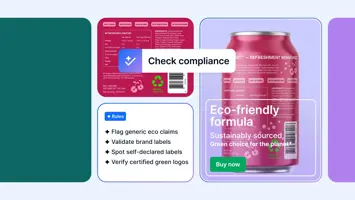
Bynder’s Brand Compliance and Governance agents eliminate that bottleneck with a continuous, automated check that runs across your entire content operations. The outcome is assurance at scale: your content is always on-brand and compliant with industry and market regulations, whenever it lives and however widely it is distributed.
This is how it works:
- DAM library compliance checks: Brand Compliance agents scan assets against your brand guidelines, such as colors, logos, typography, tone of voice, and generate detailed reports flagging exactly where and how each asset falls short. What previously required a creative director to manually review can now happen automatically at upload.
- Retired asset and outdated logo detection: Agents identify old logo variations, discontinued products, and archived campaign assets across your DAM, and trigger governance workflows to flag or remove them before they reach distribution.
- Distributor and reseller verification: Governance agents scan partner websites and external platforms to verify correct asset usage across your entire distribution network, giving brand teams visibility they have never had before.
- Subtle color variation detection: Agents catch color deviations invisible to the human eye, ensuring minor inconsistencies don’t slip through into live campaigns.
Agents act as protectors of your brand style, tone, and design for every asset entering the DAM and every asset being used online, regardless of scale.
Minimizing regulatory risk before it becomes a legal problem
Brand compliance and regulatory compliance are related but distinct challenges. For regulated industries (alcohol, healthcare, financial services, industrial, food and beverage), non-compliant assets damage brand equity and carry legal and financial consequences. They result in fines, legal exposure, and enforcement action.
As AI-generated content floods creative pipelines, the risk of non-compliant assets reaching audiences without adequate human oversight is growing. Content is being produced faster than compliance processes were designed to handle.
Bynder’s Brand Compliance Agent automatically validates assets against regulatory requirements so that risk is caught before it becomes a liability. This means marketing teams can move at the speed the business demands, eliminating compliance as a bottleneck.
Agents provide a scalable, systematic first line of defense:
- Visual analysis for legal and regulatory checks: Agents detect alcohol in imagery alongside minors, flag missing mandatory safety equipment in industrial or medical contexts, and identify regulated objects or scenarios that should not appear in branded content.
- Market-specific content rules: Different markets have different advertising standards. Agents configured with market-specific rules flag assets that may be non-compliant in particular geographies before they are distributed.
- Proactive regulatory auditing: Rather than waiting for regulators – who increasingly use their own AI audit tools – to act, agents scan your entire asset library and ad estate at scale, identifying gaps and enabling remediation before they become enforcement issues.
Bynder’s Compliance Agent enables organizations to automatically validate assets at the point of upload, preventing non-compliant content from entering the DAM.
In the age of proliferating content chaos, this matters more than ever. The cost of non-compliance is rising sharply: inconsistent brand execution alone can result in missed revenue opportunities of up to 23% and require 1.75x higher media spend to compensate.
At the same time, regulatory risk is compounding. Fines can scale per individual violation or as a percentage of global turnover, and with proactive AI scanning becoming standard among regulators, the likelihood of being flagged is rapidly increasing.
For global organizations, where a single non-compliant campaign can create significant financial and reputational exposure, automated compliance enforcement is a core risk management capability.
At Moët Hennessy, Bynder’s AI-powered agents help enforce strict brand and regulatory guidelines across a global portfolio, enabling teams to scale content production while maintaining full control over compliance. By automating governance at the asset level, they reduce manual review cycles and mitigate the risk of non-compliant content reaching the market, demonstrating how leading brands operationalize compliance as part of their content lifecycle rather than a final checkpoint.
Optimizing content performance and proving ROI
There is a final, often overlooked challenge that agents are well-placed to solve: demonstrating the value of content investment. Marketing leaders are under pressure to prove ROI. But doing so requires knowing which assets are performing, how they are being used, and where adoption is falling short. That intelligence has historically required significant manual effort to gather the right data and metrics, or has simply not existed at all.
Agents turn your DAM into a performance intelligence layer:
- Campaign adoption monitoring: Governance agents scan for the latest campaign assets across markets and partner networks, identifying adoption gaps and highlighting where local teams are not using the approved creative. For global brands managing campaigns across dozens of markets simultaneously, this visibility is operationally invaluable.
- Stock photography risk management: Agents detect instances of competitors using the same stock imagery, enabling more distinctive creative choices and stronger brand differentiation.
- Asset usage and performance tracking: Agents measure how assets are being used across channels and campaigns, providing the data teams need to justify content investment, rationalize production priorities, and retire underperforming assets.
When agents operate continuously across your DAM, performance intelligence becomes ongoing rather than retrospective. Content teams stop making decisions based on instinct and start making them based on evidence.
Agents help you accelerate business impact
The six challenges in this article share a common thread: they are systemic hurdles of scale. In today’s market, simply adding more headcount or asking creative teams to absorb more complexity isn't a sustainable path to growth.
Bynder’s AI Agents represent the next evolution of the DAM, providing the extra layer of intelligence needed to achieve the full potential of your content and accelerate business impact. By natively embedding AI Agents directly into your existing workflows where your assets, metadata, and brand standards already live, you unlock tangible outcomes: faster time-to-market, reduced agency spend, stronger brand consistency, lower compliance and legal exposure, and, ultimately, better content ROI.
This evolution remains human-led. Humans maintain absolute authority by directing the agents and owning the final outcome. Global instructions enforce your brand, tone of voice, and rules, while agent-specific prompts ensure every workflow meets your specific needs and requirements.
Ready to see AI agents in action?
Explore Bynder’s AI Agents platform and discover how leading enterprises are transforming their content operations. Visit the AI Agents product page and book a demo.