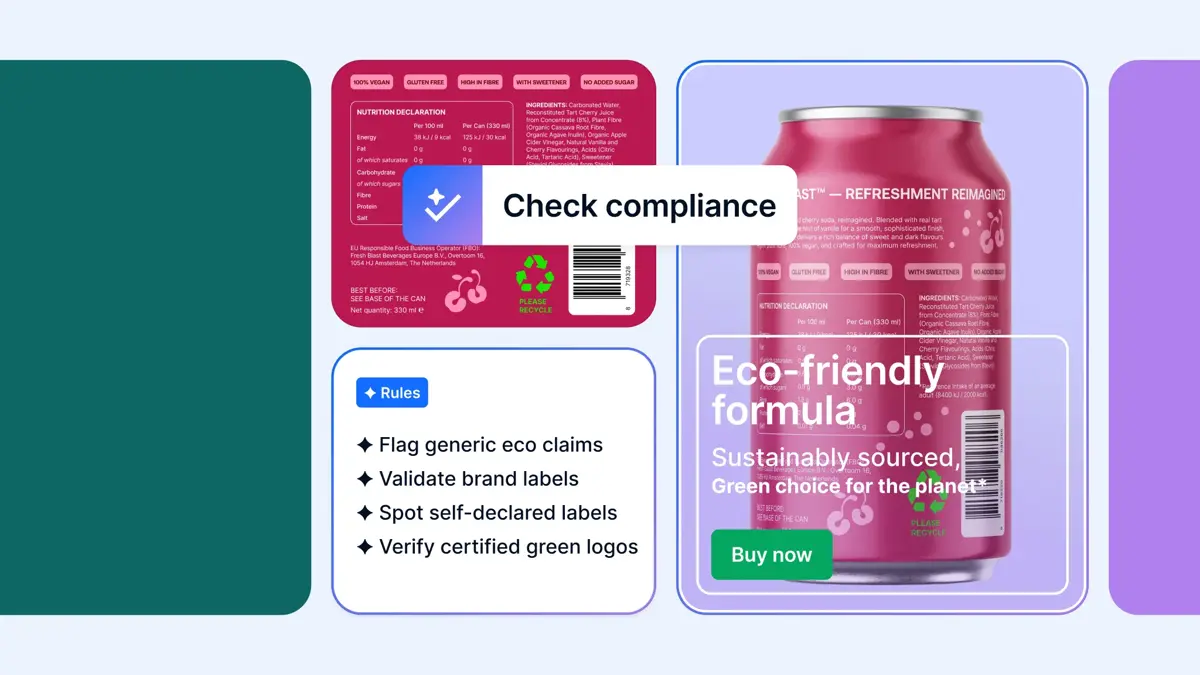
The EU is banning greenwashing in consumer-facing content, and the ban doesn't wait for your next campaign. The EU Empowering Consumers Directive, known as EmpCo, is the European Union's new greenwashing law. It applies from 27 September 2026 and covers all content that's already published, not just content published after the enforcement date. Every live product page, banner, ad, and social post carrying a sustainability claim is in scope on day one.
Key takeaways:
- EmpCo covers all consumer-facing content in the EU, including content published before the deadline, with no grace period.
- Generic claims like "green" and "sustainable" are prohibited unless supported by recognized evidence of excellent environmental performance. Offset-based claims such as "climate neutral" are banned outright.
- Penalties can reach 4% of turnover, and claims can hide in images and video, not just text, which makes discovery hard.
- A single workflow inside your DAM can find every claim across your library, attach proof with an expiry date, and route approval before publication or in a retroactive audit, replacing a manual, market-by-market audit.
- When proof lapses, a workflow can automatically remove the asset from circulation, keeping compliance status current rather than going stale between audits.
The hard part is discovery. Most teams cannot say how many assets carry a claim, and those assets live across many channels, markets, and departments.
The claims EmpCo bans outright
EmpCo removes the vague middle ground in environmental marketing. A claim needs to be substantiated with recognized proof, or it cannot be made. Generic claims like "green," "eco-friendly," and "sustainable" are generally prohibited because, in most cases, these claims are too broad to be supported by evidence. They are only permitted if a brand can demonstrate “recognized excellent environmental performance”.
Similarly, the directive clamps down on partial claims presented as whole, for example, “made with recycled material” when only the packaging meets that criteria. Forward-looking claims, while not strictly banned, require a detailed implementation planned with time-bound targets in order to meet the new rules.
Offset-based claims face a stricter rule: any claims of neutrality connected to a product (“carbon neutral,” “net zero,” or otherwise) that rely on purchased offsets are banned outright, not just conditioned on proof. Self-declared labels are out too; for example, brands can no longer invent a sustainability badge and present it as an endorsement; only official or independently certified labels count.
Why your existing content is the real risk
EmpCo applies to what you have already done, before the rules changed. There is no grace period: a product page that went live two years ago is judged against the same standard as one published that morning. For brands with large libraries and long-running evergreen content, the back catalog is where the risk concentrates.
Claims also expire. A recycled-content claim holds until its supplier certificate lapses, so a one-time audit only guarantees a clean library on the day it finishes, while the greenwashing risk is unknown six months later.
And claims are harder to find than to fix. A sustainability badge in a product shot or a percentage printed inside a campaign visual will not turn up in a text search of your website. It sits inside the image, spread across every channel and market the asset has reached.
The three questions you need to answer
- Where do we use green claims, pledges, or labels across every live asset and market, including claims inside imagery?
- Can we prove them with evidence attached to the asset that supports the claim, and a record of when that evidence expires?
- Who is allowed to publish a claim, with approval that applies before publication rather than after?
How to find, prove, and retire claims without a manual audit
When your claims, proof, and publishing controls are in one place, staying up-to-date and on the right side of the regulation can be as simple as a single, always-on workflow, rather than repeated projects. A digital asset management platform (DAM) that serves as your system of record for all digital content already holds everything needed to tackle this problem: every asset, its metadata, and the permissions controlling who publishes it.
AI agents in your DAM can be configured and customized to execute complex workflows that would otherwise require repeated audits, manually inputting information like claims expiration, and rely on users spotting risks hidden within product images. Agents - across Brand Compliance, Enrichment, Transformation, and Governance applications, use all the context in your DAM and are human-led in what specific workflows they perform and how, all directed by natural language instructions and prompts.
The seven steps to ensuring EmpCo compliance are:
- Find. Enrichment Agents and Brand Compliance Agents can cover this step, and which ones you deploy depends on the job. Enrichment Agents provide a fast “yes” or “no” on whether a claim is compliant, labeling assets with a relevant compliance status, including claims in images, PDFs, and video that otherwise wouldn’t be detected. Other metaproperties can be set to store information about logos found, claims found, and other analyses relevant for follow-up. Brand Compliance Agents come into play when legal or design teams need to review a variety of assets against multiple EmpCo rules at once, including images that carry more than one claim. They produce a detailed report that explains to the reviewer exactly why an asset failed a set of rules. Whichever Agents are set up for EmpCo compliance, the result is that intelligent workflows replace a market-by-market manual audit, and your teams review a flagged queue instead of searching for claims one asset at a time.
- Prove. Attach certificates or assessments directly to the asset making the claim, with an expiry date.
- Guide. Bynder MCP lets teams search and reference approved assets and claim guidelines while creating new content in other tools, so compliance is checked during creation, not after.
- Approve. Any asset carrying a claim routes through sign-off before publication, with a full audit trail. Agents flag and explain; your specialists still make the call.
- Fix. When an asset has embedded non-compliant text, Transformation Agents can edit the copy directly on the asset, so a wording problem does not require a full reshoot.
- Trace. Governance Agents scan the web for non-compliant assets and identify which sites have published them, so you can act on content that has traveled beyond your own channels, before a regulator finds it first.
- Archive. When a claim has to come down, archiving removes it from every portal and channel at once, closing the gap between an expired claim and a fine that can reach 4% of turnover, while protecting the brand trust that earned the sale.
Where green claims are generally used, by industry
- Fashion and apparel: product photography with material claims in copy, packaging inserts, own-brand sustainability sub-labels designed into pack imagery.
- Food and beverage: on-pack artwork, ingredient callouts, offset-based claims on shipping or packaging materials.
- CPG: packaging artwork across product variants, ingredient and sourcing claims, private-label sub-brands with their own sustainability marks.
- Retail: vendor-supplied product pages, private-label packaging, supplier certification documents attached to SKUs.
- Travel and hospitality: property listing pages, local sustainability program badges, region-specific booking site content.
Frequently Asked Questions
When does the EmpCo Directive come into force?
Does EmpCo apply to content published before the deadline?
How do you audit a content library for green claims?
*This article is for general information, not legal advice. How EmpCo applies to your business depends on your own operations and claims. Please consult your own legal counsel.