When we launched Bynder’s first company-wide AI hackathon three years ago, my goal was to use AI for product innovation: to discover new capabilities, increase platform value, and get ideas into customers’ hands more quickly. Since then, more than 15 AI-powered capabilities have made their way into the platform, from AI Search to AI Agents.
But to me, the more significant outcome of the hackathon is proof of a simple principle: AI innovation is only as effective as the human-led strategy that sets the direction, the values, and the standard of success for the problem being solved. We call that human-led, AI-powered at Bynder. When teams sit down with a problem they genuinely want to solve, they quickly discover that it can generate possibilities, accelerate execution, and surface approaches that might otherwise take weeks to explore. But it can’t decide what matters, what success looks like, or which trade-offs are worth making.
This approach came out especially in this year’s third edition of the hackathon themed: “From Prompt to Product: Think. Prompt. Deploy.” that brought together 58 participants across Amsterdam, Rotterdam, Barcelona, and remote teams in the US and UK.
Think: Why solving the right problem comes before prompting
The most tempting failure mode with AI is jumping straight to the prompt. It’s now easy enough to produce something that looks like progress when in fact you have spent two days iterating towards a polished answer to the wrong question. Fast yes, but not useful. That’s what “Think” is a guardrail against.
The mindset shift is about how AI can be useful across all three steps: brainstorming in Think, engineering in Prompt, right through to Deploy. At every step, human intelligence is needed to critically think about what problem matters and for whom.
This is what a human-led approach looks like in practice, before anyone writes a line of code. Humans decide the direction. AI compresses the distance between that decision and a working answer. Skip the first part, and you might get significant results but not particularly useful output.
To make that concrete in this year’s hackathon, I required every team to submit a PRD (product requirements document) alongside their code and pitch deck. Before anyone wrote a line of code or crafted a prompt, they had to sit down and think the project through: what’s the problem, who experiences it, what does success look like, what’s in scope. The PRD was proof of critical thinking in action, and it became one of the four criteria judges used to evaluate every submission.
What I’ve watched the hackathon institutionalize at Bynder is a different kind of collaboration: one where engineers, product managers, operations specialists, legal, and support are in the same room working on the same problem. AI makes that collaboration faster. The thinking that makes it useful still has to come first. I’ve seen this way of working which started during the hackathons translate into day-to-day engagement with our customers. By keeping them at the heart of our development, we ensure our work is rooted in understanding what they actually need and what challenges they face.
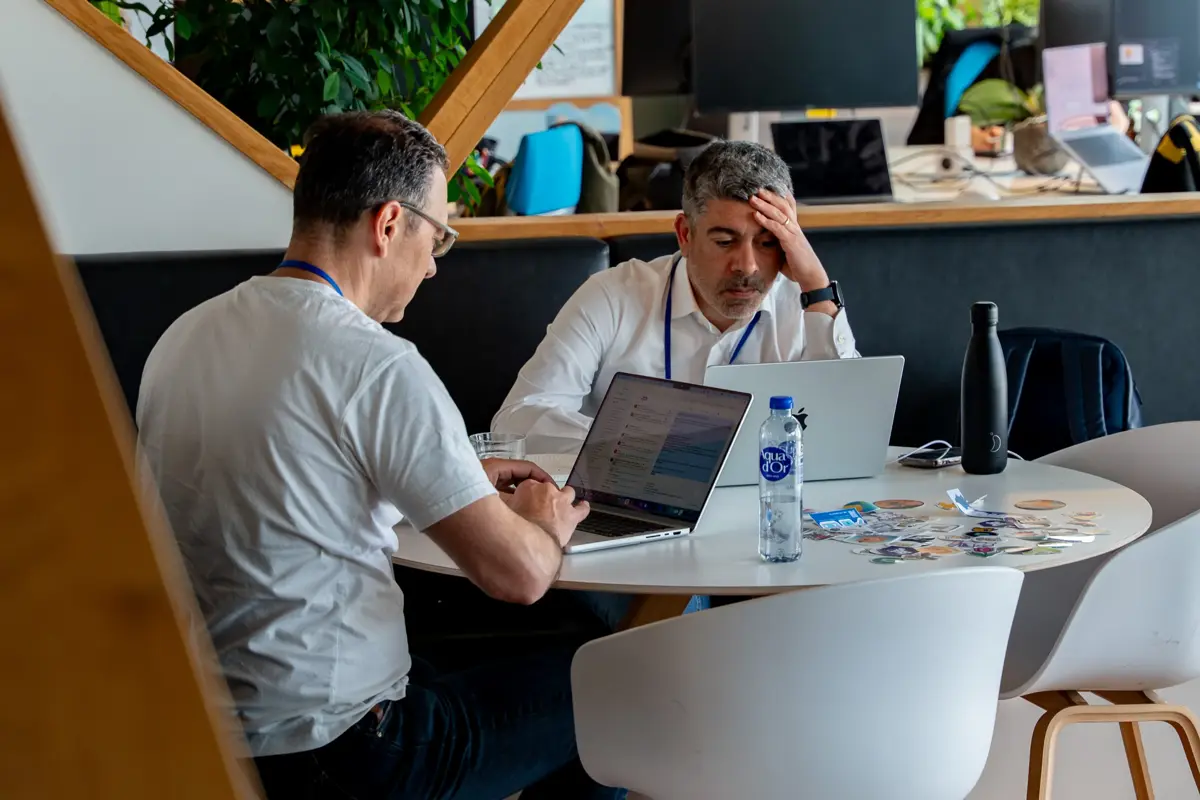
Prompt: How the right prompts multiply productivity in AI-first product development
With a clear challenge defined, AI transforms how we turn possibilities into outcomes.
This is where prompt engineering becomes a productivity lever. The teams at this year’s hackathon used Claude Code, Cowork and Design to compress the distance between a defined problem and a working prototype from weeks to hours.
Good prompt engineering is more than just getting answers quickly; it’s about providing enough context, constraints, and direction to ensure it does the right thing. The teams that moved fastest were, in fact, the ones who knew how to set up their AI tools effectively: clear scope, deliberate tool selection, and structured outputs that could be reviewed and iterated on. Prompting well is a skill, and like most skills, it grows with practice. The more precisely a team could articulate what they needed, the more useful the output.
That discipline, knowing how to direct AI rather than just activate it, is what I’ve seen prevent a productive two days resulting in an impressive demo that doesn’t survive contact with a real codebase. It’s also what makes the output of this year’s hackathon worth taking seriously as more than an internal exercise.
Three teams in particular showed what that looks like when it goes all the way through to something shippable.
Deploy: Three winning projects that show what human-led AI can build
We were joined this year by headline sponsor Anthropic, alongside AWS, Snowflake, Levi9, and ENDGAME, whose support gave teams access to frontier AI tools under genuine product-building conditions rather than controlled demo environments. That context shaped what teams were able to attempt and how far they were able to push.
This year we also introduced AI Craft as a formal judging criterion: did teams start with a clear understanding of the problem? Did they use AI to amplify their thinking? Did they build something that could survive contact with the real world beyond the pitch? The teams that scored highest were the ones that combined human direction with AI capability most effectively and strategically, knowing when to explore broadly, when to narrow focus, and when to trust their own expertise over the model’s output.
The winning projects pointed to three trends I expect to see more of across enterprise software in the next few years.
AI’s growing ability to eliminate manual work at scale
Best Overall winner: Product Recognition for DAM
Built by the Bynder AI Labs team, Product Recognition for DAM addresses one of the most persistent and labor-intensive challenges enterprise content teams face: automatically connecting every asset in a digital library to the products it depicts, without requiring teams to manually tag every image. In most enterprise DAM deployments, that connection is maintained by human effort, which doesn't scale. This team’s solution uses visual AI to do so at scale, with human-led guardrails that set the rules and review the results. It’s already being evaluated for the product roadmap, which is exactly what we want from this process.
AI-native development workflows
AI Judge’s pick winner: BEACON
AI Judge’s Pick is a new category introduced this year, powered by an AI Judge, programmed internally by one of our engineers, which evaluated all 18 submissions in parallel against the same four-criteria rubric used by the human jury.
The AI Judge’s Pick went to BEACON, built by team Prompty McAgentic-Prompt-Face. What the team built was a set of composable Claude Code skills designed to move a product idea from rough input to implementation-ready, Jira-pushed work items, grounded in how Bynder actually builds. It was the clearest demonstration at this year’s event of what an AI-native development workflow looks like when there’s genuine engineering discipline behind it. Notably, the AI Judge and the human jury largely agreed on the top performers. That alignment was, to me, itself a data point worth reflecting on.
AI moving deeper into the engineering stack
Best AI Craft winner: Span Whisperer
Span Whisperer, built by team M&O-tracing, focused on observability and distributed tracing: the kind of infrastructure work that most users never see but that directly improves platform performance and stability. The team’s approach throughout the hackathon, including structured PRDs, clean codebases, and deliberate prompt design, was precisely what the AI Craft award was created to recognize. It’s the operational side of AI-native development, and it matters just as much as the features customers interact with directly.
Fourteen other teams built things that didn’t take a trophy but showed real ingenuity. Taken together, what these 18 projects demonstrate is that AI is no longer a feature category. It’s becoming part of how products are imagined, built, and maintained from the start.
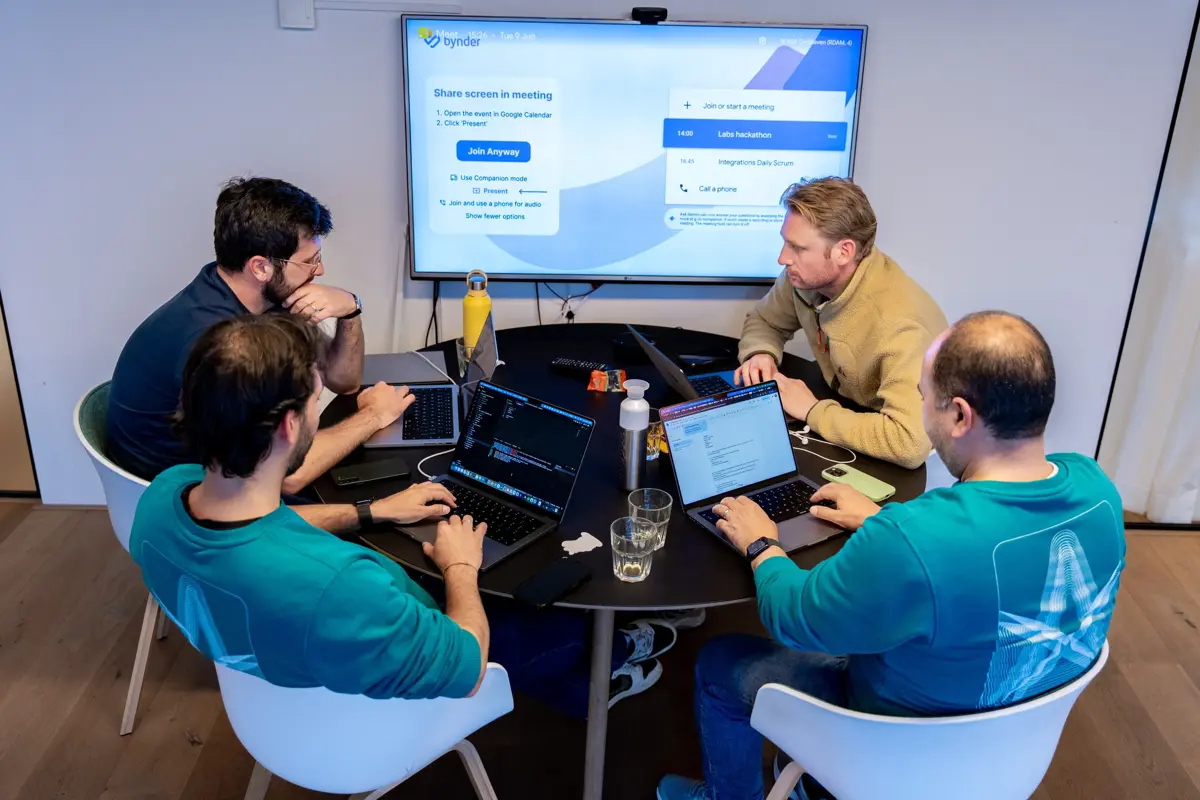
How Bynder AI Labs turns hackathon ideas into capabilities customers use today
The 15+ AI-powered capabilities that have come through Bynder AI Labs and our innovation programs are the direct result of this cycle: ideas stress-tested in the hackathon, refined through structured experimentation with involvement of our customers, and brought to market when they prove their value. These capabilities have proven to help customers reduce operational costs, increase content velocity, and drive stronger conversion, at the scale that enterprise content teams actually operate.
For example, a brand manager searching through millions of assets can find exactly what they need in seconds with AI Search, reducing the time spent on asset retrieval and freeing up capacity for higher-value work. Intelligent tagging removes the manual effort of organizing and maintaining growing content libraries, significantly reducing the time spent on metadata management while improving findability across teams. Integrated into our industry-leading DAM, the Agentic Platform lets you deploy context-aware AI Agents tailored to your business needs with enterprise-grade control and governance.
We understood early on that, for enterprise customers, it wasn’t a question of what AI could do for them but of how it could be governed. That’s why capabilities like the AI Control Center, Global AI Instructions, and Agent Builder were designed to give organizations visibility, control, and oversight over how AI operates across their content ecosystem.
I believe innovation only matters when it creates value for customers, and that means involving them in the process, not just delivering the outcome. For me, that’s the most important connection between the hackathon, Bynder AI Labs, and the platform itself.
Experimentation at Bynder doesn’t happen in isolation. Through early access programs and ongoing collaboration with customers, we test and refine ideas with the people who will actually use them. For customers, that means they’re not just using Bynder as it exists today. They’re active participants in shaping what comes next.
What three years of AI hackathons taught us about building with discipline
After three years, one conclusion stands out. The gap between “AI can do this” and “let’s actually ship this to customers” remains significant, and closing it requires a human-led approach. Governance, quality control, alignment with real user needs, setting the right directions: none of that should be automated away. All of it becomes more important, not less, as AI capabilities expand.
The Bynder hackathon has become one of the highlights of our calendar: a moment when the energy across the company is genuinely electric and produces something real. Past editions have shaped capabilities that are now in the hands of customers. This year, I’ve watched the focus shift from the ability to build with AI to the discipline to build well.
I’m already looking forward to next year.
TL;DR
What is Bynder’s approach to AI innovation?
Bynder’s approach is built around the principle of human-led, AI-powered development: humans set the direction, make the judgment calls, and decide what success looks like, while AI accelerates execution. This philosophy is put into practice through Bynder AI Labs and the annual Global AI hackathon, which brings together cross-functional teams and customers insights to rapidly prototype ideas, validate them against real needs, and move from curiosity to something shippable under real conditions.
How does Bynder turn hackathon ideas into real product features?
Bynder AI Labs acts as the bridge between hackathon experimentation and platform capability. Promising projects are evaluated for technical rigor, scalability, and customer value, then refined through early access programs and direct customer collaboration before being assessed for roadmap fit. To date, AI Labs has helped shape more than 15 AI-powered capabilities across the Bynder platform.
What is Bynder AI Labs?
Bynder AI Labs is part of our innovation programs focused on rapidly testing emerging AI technologies and identifying new opportunities to deliver value to enterprise customers. It connects the ideas generated by the annual hackathon to Bynder’s product development process, ensuring that experimentation, validated with customers, has a clear path to production.
What does human-led, AI-powered mean in practice?
It means AI is treated as an accelerant, not a strategic decision-maker. At every stage of development, from ideation and development to testing and shipping, human judgment drives the decisions that matter most: what problem to solve, whether the output meets the bar, and how the result should be governed. The hackathon makes this concrete every year: the teams that perform best aren't the ones who delegate the most to AI. They're the ones who know precisely when to trust it and when to intervene.
How did Anthropic’s technology contribute to this year’s hackathon?
Anthropic served as headline sponsor of the 2026 Bynder Global hackathon, with teams building with Claude and Claude Code throughout the event. Claude also powered the AI Judge, an independently built tool that evaluated all 18 submissions in parallel with the human jury. The collaboration gave Bynder teams extended, high-pressure experience working with frontier AI in a real product context, and the results across multiple winning projects reflected that depth of engagement.