Human-led AI is an approach to agentic AI in which humans retain full direction and control, defining what agents do, how they operate, and what standards they must meet, while AI executes the work at scale. For enterprise marketing and brand teams, this matters because AI agents can now operate across the entire content lifecycle: enriching metadata, checking brand compliance, transforming assets, and governing distribution across markets. That scale of automation is only safe and sustainable when humans remain in the driver’s seat, not just in the loop.
- Why AI at scale amplifies content risk
- What human-led AI means in practice
- Global rules, permissions and natural language configuration
- Human review workflows and approvals
- Why native DAM integration makes AI governance possible
- The business case for human-led AI at scale
- Frequently asked questions
This article explains what human-led AI looks like in practice for DAM workflows, why it is the right approach for content operations at scale, and how Bynder’s AI Agents are built around this principle.
The question for enterprise marketing and brand leaders has therefore shifted. It's no longer a question of whether to use AI agents in content operations, or even what those agents are capable of in isolation. It’s whether you can rely on them to perform consistently, at scale, without surprises. It’s how to stay in control of them, and the answer starts with where your agents operate: inside a governed system of record, not alongside one. A DAM that acts as a system of record for digital content provides the foundation for approved assets, permissions, taxonomy, and compliance controls that enable responsible agentic AI. Build on that foundation, and you can unlock speed and scale without compromising governance, security, or brand integrity.
Key takeaways:
- AI at scale amplifies not just existing risks but any problem you might have in your DAM: hallucinations, brand drift, outdated and expired assets, duplicate images, assets with no metadata, and products that are no longer being sold.
- Human-led AI means directing agents clearly, owning the final outcome, and embedding control at the right moments.
- In practice, this means: global rules and permissions, natural language configuration, human review workflows, and agents built natively within your DAM.
- When agents operate inside a governed system of record for all digital content, you get scale without sacrificing brand safety or governance.
- The result is measurable: operational efficiency, productivity gains, and financial returns that compound over time.
The risks of ungoverned AI in content operations
AI at scale amplifies content risks that already exist (brand inconsistency, compliance failures, and inaccurate outputs) and moves them faster than manual oversight can catch.
What risks does AI introduce in content operations?
Marketing teams are generating more content than ever. Regulators and legal teams are paying closer attention to what gets published, while customers across an expanding number of digital channels are quicker than ever to call out content that looks inconsistent, inaccurate, or off-brand. These pressures are growing in opposite directions: one from the top down, one from the outside in. AI, without the right governance, accelerates both.
How can agentic AI cause brand inconsistency without the right guardrails?
Generative AI introduces risks that didn’t exist with traditional tooling. Hallucinated outputs, where AI produces inaccurate or entirely fabricated content, are a documented reality. So is unintended brand inconsistency: generic generative AI tools used without guardrails can modify far more than intended. Ask it to swap an image background, and it may alter the product itself, a perfume bottle, a car, or a logo. The exact assets brands care most about protecting. This is precisely what Bynder’s Transformation Agent is built to prevent, applying AI to background and context changes while preserving the core product visual from modification.
Why does AI inconsistency compound at scale?
Then there is the subtler risk of inconsistency at scale. When agents haven’t been given global instructions covering tone, voice, structure, and format, outputs vary depending on who last configured or ran them. One person generates alt text in a precise, brand-consistent style; another generates it in a completely different structure and register. Neither is technically wrong. But at scale, the inconsistency compounds, and a brand that looks different depending on who touched the asset last is a brand that loses its integrity at the exact moment it’s trying to scale.
What do enterprise teams cite as their biggest AI adoption concerns?
The scale of these concerns is already registering at the enterprise level. Research from Bynder’s 2026 State of DAM report found that one in four businesses (25%) are concerned about inaccurate or hallucinated AI outputs, while an even higher proportion name legal and regulatory compliance risks (27%), and security issues (28%) as concerns when integrating AI models into existing systems. These are mainstream barriers to adoption, and they’re exactly what a human-led approach to agentic AI is designed to address.
The solution is to deploy AI agents purpose-built for DAM workflows, operating inside a governed system of record rather than alongside it. A DAM that serves as a system of record for digital content already provides the foundation your agents need: approved assets, an established taxonomy, configured permissions, rights information, and compliance controls. Your data stays in your instance, governed by the same admin console and permissions already in place. This is an enrichment agent operating within your existing governance structure, under human control, producing outcomes your legal team can stand behind.
What does human-led AI mean for agents in DAM?
There’s a concept that sits at the heart of Bynder’s approach to agentic AI: human-led, AI-powered.
Humans decide where and how agents operate across the content lifecycle, from ingestion and enrichment, through transformation and compliance checks, to distribution. Humans set the direction, agents do the work.
In practice, control requires three things:
- Clear direction at the start, configuring agents with specific instructions, rules, and business context before they run.
- Meaningful visibility during execution, which means being able to see exactly what every agent has done, review its outputs side by side with the originals, and approve, edit, or reject at the asset level or in bulk.
- The ability to course-correct when needed. Nothing is irreversible: outputs can be undone, rules can be updated, and agents can be reconfigured as your standards evolve.
A DAM that serves as a system of record for digital content provides the governed foundation that makes all three possible, with enterprise-grade security and permissioning constraining agent behavior by default, even without active oversight at every step.
An agent is useful because a human has told it precisely what to look for, how to behave, and what matters to a specific brand, industry, and use case. That might mean instructing a compliance agent to flag every image where alcoholic beverages outnumber people, because your brand operates in a regulated market and that ratio signals a risk of encouraging overconsumption. No generic AI tool arrives at knowing that rule, a human writes it.
Having a human-led agenda is our philosophy and our approach to agents. You do need to have control and governance to course correct where things are... We want to make sure that we can actually deploy them effectively as part of our overall system of record.Dominique LeBlond
Chief Product Officer at Bynder
What this looks like in practice is more specific than it sounds. A customer using the Enrichment Agent to generate metadata doesn’t simply switch it on and accept whatever it produces. They configure it with instructions that reflect their DAM’s taxonomy, specify which fields output should populate, define the vocabulary and formatting, and tell the agent how to handle edge cases. The output arrives in the right format, in the right fields, in the right voice, because a human designed those requirements before the agent ran.
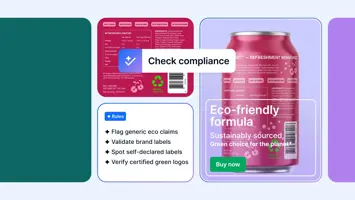
Similarly, a customer setting up the Brand Compliance Agent doesn’t hand it a vague brief. They write a set of binary rules, each one deterministic and unambiguous, organized by asset type and brand element: logo usage rules for branded assets, photography rules for both stock and shoot content, and tone of voice rules for text. The human is the brand expert who authors the standard. The agent enforces it at scale.
Centralized AI governance: global rules, permissions, and natural language prompts
Control over AI agents begins with their configuration, before they even run.
Bynder’s AI Control Center is the central hub for managing your AI agents, the place where you set global rules, configure individual agents, and ensure humans lead at every stage.
Teams use the AI Control Center to define global AI instructions, essentially a company-wide AI style guide written in natural language, covering brand tone of voice, industry-specific language requirements, regulatory compliance rules, content formatting standards, and safety guardrails that direct agents to flag or refuse requests that fall outside defined boundaries.
Each agent is then configured separately, where teams specify the precise task, context, and output requirements for that workflow: what the agent should look for, how it should behave, what fields to populate, and what rules apply to the specific assets it will run on. Global instructions set the standards that apply everywhere; agent-level prompts set the instructions for this agent, this task, this business need. Both are written in plain language, the way a human would describe the job to a colleague, with no coding required.
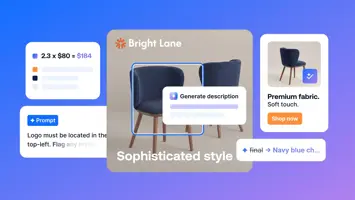
For example, an Enrichment Agent can be instructed to act as a specialized industry expert focused on generating metadata, with additional prompts specifying the vocabulary, the output structure, which DAM fields to populate, and how to handle different asset types.
A Transformation Agent can be told to generate and apply Christmas-themed backgrounds to a set of campaign images, with an optional reference image to capture the right visual style. In both cases, the human describes the task in natural language. No encoding, no technical translation required.
AI permissions add another critical layer. Not every team member should be able to configure, deploy, or run every agent. Bynder’s permission profiles let administrators define precisely who can create agents, who can initiate runs, who can view outputs, and who has approval authority, providing enterprise-grade control over agent access and reducing the risk of AI misuse or regulatory abuse.
Built-in controls also prevent brand distortion due to inappropriate asset transformation or content generation. For example, during transformation workflows, key product visuals (e.g.: a product bottle, a brand mark, a hero product image) can be preserved from AI manipulation, ensuring the transformation agent modifies only what it’s supposed to. These guardrails are the practical difference between responsible automation and automation that works against you.
Tools and workflows for human review and approvals
Human-led AI requires meaningful visibility into what agents are doing and the ability to intervene at any point, not just at configuration.
Configuration is only part of the picture. Human-led AI also requires meaningful visibility into what agents are actually doing and the ability to intervene when needed.
Bynder’s Workspace is the unified hub for agent-driven workflows, giving teams visibility over all agents and AI activity in one place. Within the Workspace, the Agent Activity page gives teams full visibility into every agent action. All outputs are reviewable, with side-by-side comparisons of the original asset and the suggested change. Teams can approve or discard outputs individually or in bulk. Complete audit trails log the status, history, assets processed, and agent name associated with every run, to trace every change and to account for every action.
When trust in an agent’s outputs has been established over time, teams can activate auto-apply, meaning the agent’s suggestions are applied automatically without requiring individual review. This is the natural progression: start with close human review, build confidence in the agent’s outputs, then progressively minimize human involvement. If something ever needs to be reversed, a one-click undo function instantly rolls back an entire batch run and restores all assets to their previous values. Knowing there’s always a safety net is what Bynder means by scaling with confidence.
Automation Workflows take this further by enabling multi-step content workflows that automatically trigger agents based on the exact conditions you define. A workflow might specify that any new asset tagged for web use automatically triggers the Brand Compliance Agent, followed by the multilingual alt text Enrichment Agent. If the compliance check returns a partial or non-compliant result, the workflow stops there, and a report is available for the team to review. If the asset passes, it moves forward without manual intervention. The workflow encodes your decisions about when automation runs, what it does, and precisely when a human needs to be involved. That level of control is not a feature layered on top of the agents, but it’s how responsible automation is architected.
This is what it means to control where agents operate across the content lifecycle: a deliberate architecture of when automation runs and when human eyes are required.
Human oversight can be embedded at specific points in the content lifecycle rather than applied uniformly. An Enrichment agent running on newly uploaded assets might not require individual approval for every metadata suggestion. A compliance check before an asset is cleared for external use might start that way, too, until trust in the agent’s outputs at scale is established and auto-apply takes over. Bynder lets teams make those decisions intentionally, deploying oversight precisely where it’s most valuable, rather than creating friction everywhere.
Agentic DAM built for enterprise
AI agents are only as trustworthy as the system they operate within and a governed DAM provides the foundation that makes human-led AI possible at scale.
There’s a fundamental architectural difference between AI agents that are bolted on to a DAM and agents that are built natively within one.
Bynder’s AI Agents operate inside the DAM that has been established as the system of record, the single, governed source of truth for every digital asset your brand owns, and after it’s already been strategically deployed. That means they work with full context: the actual assets, existing metadata, established taxonomy, configured permissions, rights information, and workflow rules. When an Enrichment Agent runs, it reads existing metadata to generate more accurate, contextually relevant suggestions. When the Brand Compliance Agent evaluates an asset, it does so against your specific brand rules, not a generic model’s approximation of them.
This native integration enables precise control. Agent Knowledge lets you extend the Enrichment Agents' understanding with custom reference materials, a product specification sheet that teaches an agent to correctly identify specific product variants, or a location datasheet that maps regional identifiers so an agent can accurately tag assets by geography. This depth of business context is only possible because Bynder’s AI Agents are natively built for Bynder’s DAM.
The EU AI Act’s high-risk obligations become fully applicable in August 2026, according to Dataversity’s 2026 AI governance analysis, adding urgency to enterprise AI governance programs already underway.
The enterprise-grade security and architecture also provide reassurance on the question that legal and IT teams ask first: where does the data go? The answer is: nowhere. Your assets stay inside your Bynder instance, governed by the same permissioning and compliance controls already in place. Bynder’s AI Agents operate within those walls, and their responsible deployment runs inside your existing governance structure, always human-led, producing outcomes your legal team can stand behind. Bynder’s agentic platform is also designed to meet evolving AI regulations and data usage law requirements, with a privacy-first, secure cloud architecture governing every aspect of how data is handled.
The business case for human-led AI at scale
The most forward-thinking organizations are treating responsible AI as the foundation that makes the power of AI agents safe and sustainable. Prioritizing a human-led, enterprise-ready approach to agents is a genuine competitive differentiator.
The business outcomes map to three dimensions:
- Operationally, deploying human-led, AI-powered workflows eliminates the business risk and loss of control that autonomous, ungoverned AI introduces, replacing manual, time-consuming compliance and enrichment processes with automated workflows that run at scale, without sacrificing accuracy.
- From a productivity standpoint, Bynder’s AI Agents increase teams capacity and amplify impact by handling the repetitive, time-consuming workflows that slow teams down. Teams can configure and deploy an unlimited number of agents, each tailored to a specific business need. One agent handles metadata enrichment for product assets. Another enforces photography rules for campaign imagery. Another generates multilingual alt text on upload. Each one is purpose-built through natural language configuration, meaning the productivity gain scales with the complexity and specificity of the business, not just with volume.
- Financially, the returns work in both directions. On the cost side: reduced agency spend, lower cost-per-asset, fewer compliance failures, and greater asset reuse across markets and channels. On the revenue side: better-performing campaigns from more consistent, personalized content, higher engagement and conversion rates from assets optimized for every channel and audience, and faster time-to-market that means more campaigns executed within the same budget.
The organizations that will win in the agentic AI era are those that deploy agents within a governed system of record for all their digital content, with clear global rules, enterprise-grade permissions, meaningful human oversight, and the confidence to scale content operations without ever losing control of the brand behind them.
Ready to see AI agents in action?
Explore Bynder’s AI Agents platform and discover how leading enterprises are transforming their content operations. Visit the AI Agents product page and book a demo.
Frequently Asked Questions:
What is human-led AI in content operations?
What is AI governance in a DAM system?
How do AI agents stay in brand compliance?
What is an AI Control Center in DAM?
How does human-led AI reduce compliance risk in content operations?
Why is a DAM the right foundation for AI agents?
Can non-technical teams configure and govern AI agents?
See how Bynder’s AI Agents work in practice, including how to configure agents for your specific use case.