The digital shelf has changed how food and beverage brands manage content
Food and beverage brands are no longer just managing campaigns. They are managing content ecosystems for every product across retailer product pages, partner websites, marketplaces, social commerce, quick-commerce apps, mobile experiences, and global and regional e-commerce environments, each with its own format requirements, content standards, and update cycles. At the same time, packaging changes, ingredient updates, localized claims, and regulatory reviews keep moving the goalposts. In that environment, content is an essential driver of visibility, conversion, and trust.
The industry findings in the State of DAM 2026 report show that this pressure is landing in a market already being reshaped by AI: 97% of businesses said AI market trends have affected their content operations, and, on average, 41% of content is already AI-touched. As content complexity increases and AI plays a key role in workflows, the burden is shifting from simply producing enough content to keeping content accurate, approved, and ready to use across far more endpoints.
Key takeaways
- As product content multiplies, food and beverage teams are being asked to manage far more assets, versions, and variants across channels, markets, and retail environments than ever before.
- AI is already accelerating content creation, but for many food and beverage brands it is not solving the harder operational challenge of keeping content accurate, compliant, localized, and ready to activate at scale.
- The more important strategic shift is toward using AI to strengthen content operations, because growing complexity in metadata, compliance, approvals, localization, and asset transformation is exposing the limits of weak infrastructure.
- As digital shelf visibility becomes more directly tied to sales, the competitive advantage will not go to the brands creating the most content, but to the ones that can operationalize it fastest and most effectively.
SKU proliferation is driving a massive increase in content
SKU complexity is not new in food and beverage, but the demands around it have changed. What once sat largely within packaging and campaign workflows now has to support retailer product pages, localized shopping experiences, channel-specific formats, and market-specific claims, all at the same time. A single product can require pack shots, packaging renders, nutrition labels, ingredient lists, PDP assets, retailer-specific formats, localized claims, and promotional variants, often with legal, product, brand, ecommerce, and regional teams all involved before anything is approved for use.
What has changed is not just the volume of content, but the operational risk attached to it. Reformulations trigger fresh review cycles, seasonal launches multiply asset requests, and regional teams need channel-ready assets that reflect different claim requirements by market. Retailers and digital channels now expect content tailored to specific formats, regions, and shopping experiences, while evolving rules on nutrition labels, ingredients, and sustainability claims raise both financial and reputational risk if non-compliant assets end up in the field. That is why product content now behaves less like campaign collateral and more like day-to-day operational infrastructure, with the strain showing up in slower approvals, outdated PDP content, duplicate work, more asset requests, and more pressure on retailer execution.
The real bottleneck: content infrastructure
In food and beverage, metadata is often at the center of the problem with content infrastructure, because it determines whether product content can actually function in the market and whether the right assets are discoverable when needed. Metadata ties assets to SKUs, ingredients, allergens, pack types, claims, markets, channels, rights, and approvals. It also supports product search, retailer syndication, localization, compliance, and personalization. When that layer is weak, assets may still exist in abundance, but teams are less certain they are using the right version, less able to find what they need quickly, and more likely to recreate work that should already be ready to use.
The State of DAM ‘26 findings make that challenge clear. Within this category, 38% said enriching assets with custom metadata is an outstanding challenge, even given the current automation features and tools in their DAM, while this is one of the least common challenges named in other industries. That matters because in food and beverage, unreliable metadata does not just slow teams down; it makes product content harder to activate accurately across the digital shelf.
Beyond metadata, more than 1 in 5 said a lack of AI-driven automation is a barrier to activating content effectively. Those numbers point to the same issue: content creation is speeding up, but the infrastructure needed to classify assets, govern approvals, and keep retailer-ready content moving is not keeping pace.
For brands, the day-to-day consequences are expensive precisely because they are so easily overlooked when generating more output takes priority. Designers rebuild assets that already exist because the version needed has been lost; brand teams chase approvals through email and chat because the workflow is still scattered; ecommerce teams wait for current pack shots and retailer-ready files while launch windows narrow; and regional teams work around incomplete metadata or outdated packaging that has already made its way onto partner sites and storefronts. The result is not just delay; it is wasted production budget, slower time-to-market, and a greater risk of inaccurate or non-compliant content reaching live channels.
In an industry where the digital shelf directly influences visibility and sales, that kind of friction does not stay operational for long; it becomes commercial.
AI is accelerating content production, but not solving the scaling problem
AI is already changing how work gets done for food and beverage marketing teams, and the adoption figures make that hard to dispute. Even when AI tools help teams produce more content at faster speeds, this increased rate of production does not resolve the harder operational problems. In this industry, 36% of businesses said the rise of AI generally—with the shifting expectations it has brought—has actually made it more difficult to scale personalization and localization, higher than the cross-industry benchmark of 27%. That reflects a broader pressure emerging in the industry: 97% of food and beverage businesses said AI market trends have introduced new complexity in their content operations, including more people and teams needing access to content, a higher risk of off-brand or inconsistent execution, and more difficulty maintaining governance and compliance as volume and variation continue to rise.
Bynder’s State of DAM ‘26 report also shows that brands are applying AI unevenly across their content operations. Brands are most likely to already use AI for content discovery and search, at 62%, while asset organization and management remain the least likely area where brands are turning to AI for support.
That split is revealing. It is relatively straightforward to apply AI where the benefit is immediate and visible, whether that means finding assets faster, generating new variations, or speeding up first drafts. But AI’s potential is still unrealized when it comes to the work of building the right foundation for content to actually move at scale: keeping retailer updates current, managing localized claims across markets, maintaining clear version history, routing approvals across teams, and making sure the right asset reaches the right channel in the right format. In practice, that means content can be produced faster than it can be activated effectively, or trusted for compliance, accuracy, and consistency.
This is the shift many enterprise teams are now feeling in practical terms. The problem is no longer generating enough content; it is what happens next, when that content has to be approved, localized, reformatted for retail partners, matched to the right product data, and released without creating another round of manual checking.
As AI expands the volume and variety of content that teams can create, it also exposes how many workflows still depend on fragmented systems, manual reviews, and content structures that were never built for this level of scale and variation. Across the broader market, 93% of businesses said they currently face content challenges that current rule-based automation alone cannot solve, which underlines a broader point: volume amplifies operational weakness as quickly as it amplifies output.
The digital shelf demands operational AI, not just creative AI
Most food and beverage brands have started their AI journey in the same place: creative output. Image generation, copywriting, and ideation are visible, fast, and easy to demonstrate. That is a reasonable starting point, but it is not where the real leverage lies. The bigger shift is toward operational AI: using AI to enrich, govern, transform, and move content through approval and activation workflows with less manual friction. When current and planned AI use are combined, 95% of businesses say they already use or will use AI for workflow automation and efficiency.
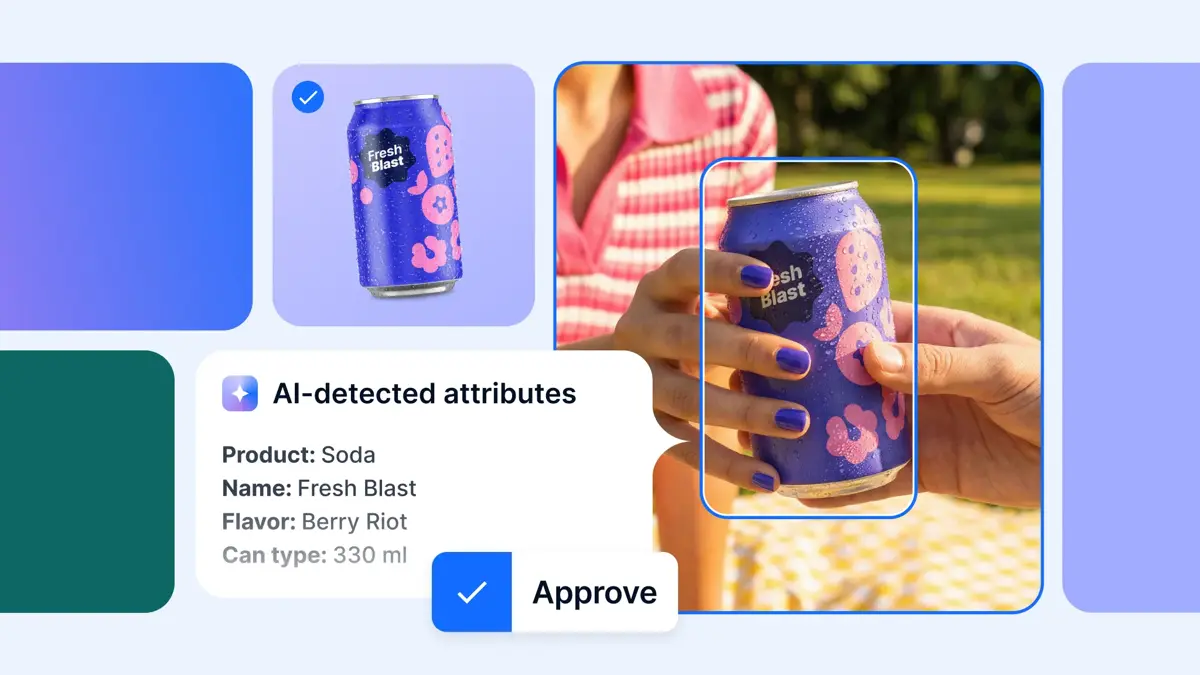
That is where an agentic approach starts to matter. Instead of relying on isolated AI features that handle one task at a time, teams can use AI Agents to support more complex, multi-step work. In practice, that can mean enriching assets with business-specific metadata, detecting off-brand, outdated, or non-compliant content, and adapting approved assets for different retailers, regions, and formats. In food and beverage, where claims vary by market and packaging changes can trigger fresh review cycles, that kind of support is not just efficient. It helps teams keep content accurate, current, and ready to activate.
It also does not remove human judgment. Brand, compliance, and regional teams still need control over what reaches live channels. The value lies in reducing the repetitive, high-volume work that slows teams down and creates avoidable risk. For food and beverage leaders being asked to scale content operations without scaling headcount at the same rate, that matters. Faster time-to-market, fewer approval bottlenecks, less rework, and fewer errors reaching retailer pages are where the gains start to become real.
Why content infrastructure is becoming a competitive advantage
As content operations in food and beverage evolve, businesses are unlikely to see significant rewards from speed alone; instead, growth will be predicated on whether a business can move quickly without losing control. This is reflected in where businesses expect to see the most value from AI agents. Among the businesses surveyed, 42% said AI agents could reduce manual checks and human error in content operations.
This kind of value also shows up when stronger content infrastructure helps teams make faster, more accurate decisions while reducing manual work behind the scenes. At Pernod Ricard, AI has improved asset discovery and reduced the time teams spend identifying duplicates and manually managing content, making workflows more efficient and content usage more meaningful.
Bynder AI has exceeded our expectations, providing much greater precision in asset discovery. It’s also saved our teams countless hours spent manually identifying and managing duplicate assets, improving platform cleanliness, and ensuring that content usage rates are more meaningful.Fedor Ivashkin
Product Owner at Pernod Ricard
And the gains are already visible: in the last 12 months, 35% of CPG and FMCG respondents said AI in DAM helped accelerate time-to-market for content or products. Looking ahead, 36% expect AI to improve operational efficiency and strengthen governance and brand outcomes. For food and beverage leaders, that is the most useful way to read the moment. The stakes for managing content operations at scale are rising, and digital shelf visibility directly affects sales, while growing content volumes can quickly demand far more budget, time, and resources than teams can absorb if they are not managed properly.
The next competitive advantage in food and beverage marketing
The brands that succeed with AI will not simply create more content; they will build systems that allow them to activate product content across the digital shelf, localize at scale, maintain compliance, and measure ROI in a way the business can actually act on. As pressure on teams continues to rise, the competitive advantage will not belong to the businesses producing the highest volume of assets. It will belong to those who can operationalize content fastest and most effectively, bringing products to market faster, keeping retailer content current, and reducing the friction and waste that slow teams down.